CERN and Mistral Partner to Build AI Foundation Models for Physics
- CERN and Mistral AI signed a statement of intent to establish a long-term partnership on foundation models for scientific discovery.
- The partners plan to develop a “Large Physics Model,” which CERN says would be the first foundation model for collider physics.
- The model would be trained on billions of simulated particle collisions and could replace some specialized algorithms for reconstructing and identifying particles.
- CERN has about one exabyte of Large Hadron Collider data, while the partnership’s timeline and budget have not been disclosed.
18 Articles
18 Articles


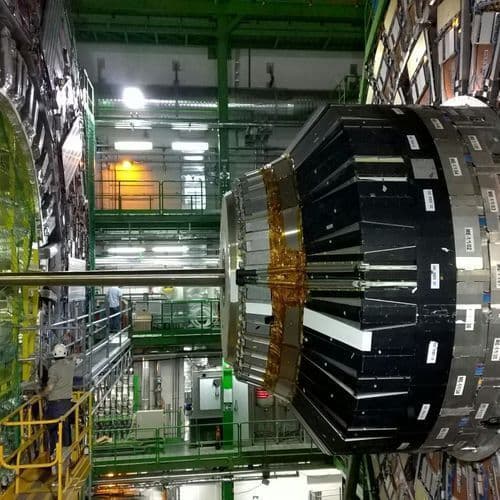
According to a joint statement, this model will facilitate the analysis of the data of the Great Hadron Collider (LHC), the world’s largest and most powerful particle accelerator, located near Geneva. This accelerator collides particles at extreme speeds within a ring. These collisions allow for a better understanding of their properties. Researchers already use artificial intelligence to analyze data recorded by LHC detectors. However, current …

CERN currently has about one exabyte - one million terabytes - of experimental data, a treasure trove for training the new model of the French Mistral. The post "Large Physics Model" will be trained with CERN data for the sake of science appeared first on in.gr.

The European Organization for Nuclear Research (CERN) and Mistral AI want to teach an artificial intelligence (AI) to read the particle collisions of the Great Hadron Collider (LHC). A world first, which could change the way physicists explore the infinitely small.

On Thursday, October 15, 2026, CERN and Mistral AI signed a declaration of intent to create a "big model of physics," led to billions of simulated collisions at the LHC. No budget or schedule has been communicated.

Coverage Details
Bias Distribution
- 57% of the sources are Center


Factuality
To view factuality data please Upgrade to Premium