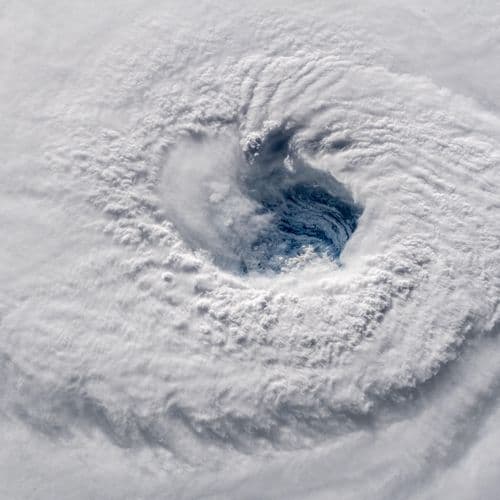
Why AI has trouble predicting the fury of hurricane intensity
Researchers say sparse ocean observations and model limits keep AI from reliably forecasting rapid hurricane strengthening.
- On Sept. 21, 2026, Hurricane Polo rapidly intensified from a tropical storm to a powerful Category 5 hurricane in 24 hours off Mexico's Pacific coast, reaching 180 mph winds.
- Scientists training Artificial Intelligence models rely on observations and simulations, but both sources remain incomplete; observational data is sparse over open oceans while computer simulations contain approximations that fail to capture fine-scale processes.
- Research by Indiana University Associate Professor of Atmospheric Science Chanh Kieu suggests hurricanes may contain chaotic elements that prevent Artificial Intelligence from achieving perfect intensity predictions, as small disturbances cause fluctuations models cannot track.
- Minimizing forecast error often leads Artificial Intelligence models to smooth out unpredictable fluctuations, creating a dilemma where systems learn the most likely storm evolution but fail to capture intrinsic chaos.
- Future weather forecasting systems should prioritize a range of possible hurricane intensities and their probabilities instead of single numbers, a shift necessary to account for uncertainty in complex atmospheric conditions.
11 Articles
11 Articles


Why AI has trouble predicting hurricane intensity
THE CONVERSATION: Artificial intelligence (AI) has revolutionised weather forecasting in just a few years, with global AI weather models now able to produce forecasts that rival some of the world’s best physics-based prediction systems. This remarkable progress has been driven by three factors: massive amounts of weather data, advances in AI models, and unprecedented computational power. While most of the current discussion on improving AI for w…
 The Conversation


Why AI has trouble predicting the fury of hurricane intensity
Hurricane Irma rapidly intensified before hitting the Caribbean and Florida in 2017, but intensity is still hard to forecast. NASAArtificial intelligence has revolutionized weather forecasting in just a few years, with global AI weather models now able to produce forecasts that rival some of the world’s best physics-based prediction systems. This remarkable progress has been driven by three factors: massive amounts of weather data, advances in A…

Even perfect data may not make hurricane forecasts as accurate as possible: In an idealized storm model, researchers have found indications of low-dimensional chaos in intensity. Small differences grew so rapidly that wind intensity could only be predicted over a few hours at the maximum intensity level. This could also set a principle limit to artificial intelligence (AI) systems. Bloomington [...] The article Why is hurricanes' strength diffic…
Coverage Details
Bias Distribution
- 67% of the sources are Center


Factuality
To view factuality data please Upgrade to Premium