Published • loading... • Updated
Isle of Wight fossil sheds light on enigmatic meat-eating dinosaurs
Researchers named Invictibellatrix amberina after reexamining a century-old skull fragment that fills a major gap in megaraptoran evolution.
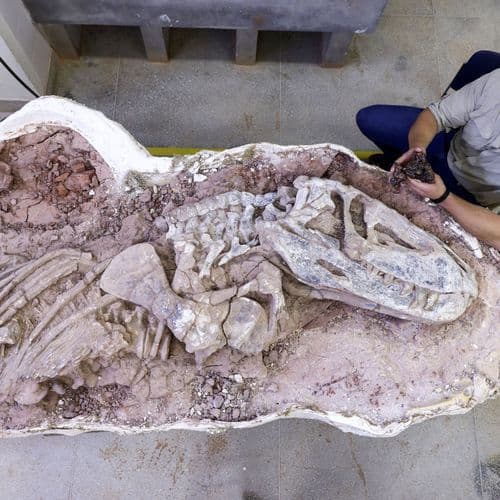
- Researchers identified a new megaraptoran dinosaur species, Invictibellatrix amberina, from a fossil discovered on the Isle of Wight that sat in a London museum drawer for nearly 100 years.
- Living about 120 million years ago, this tiger-sized predator is the first megaraptoran identified in Europe, providing critical evidence for theories regarding the group's global migration during the Cretaceous Period.
- Lead author Cassius Morrison noted the name Invictibellatrix means "unconquered female warrior." The study, published in Royal Society Open Science, describes the creature as an agile hunter with massive hand claws.
- Unlike Tyrannosaurus, which hunted with brute force, Invictibellatrix relied on agility and maneuverability. University College London doctoral student Charlie Scherer noted the fossil was "overlooked" for study for over a century.
- These findings help scientists understand the evolution of mysterious theropod groups. Megaraptorans later became apex predators in South America, Australia, and Antarctica, while tyrannosaurs became the dominant "tyrant kings" in North America and Asia.
Insights by Ground AI
27 Articles
27 Articles
 Kreiszeitung
+5 Reposted by 5 other sources


The Invictibellatrix amberina was discovered using a fossil acquired by the Natural History Museum in 1924.
·Syke, Germany
Read Full Article
 Evening Standard
+4 Reposted by 4 other sources


New species of dinosaur discovered from fossil ‘overlooked’ for over 100 years
The dinosaur is a long-clawed predator the size of a large tiger.
·London, United Kingdom
Read Full Article


Scientists have identified a previously unknown long-clawed predator that roamed Britain 120 million years ago - and say humans would have been the perfect
Coverage Details
Total News Sources27
Leaning Left4Leaning Right2Center13Last UpdatedBias Distribution68% Center
Bias Distribution
- 68% of the sources are Center
68% Center
L 21%
C 68%
11%


Factuality
To view factuality data please Upgrade to Premium