CERN Shuts Down Large Hadron Collider for $1.5B Upgrade
The $1.5 billion overhaul will rebuild the ATLAS and CMS detectors and raise collision rates by a factor of 10, CERN said.
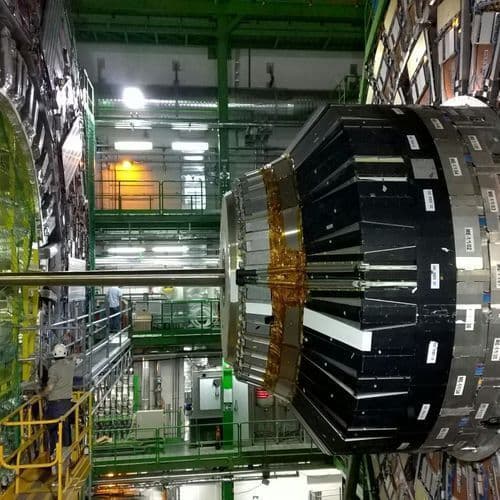
- On Monday, the Large Hadron Collider began a planned 47-month shutdown, marking its longest hiatus to date to undergo major overhauls of the ATLAS and CMS detectors.
- Scientists designed the upgrade to increase the collision rate by a factor of 10, enabling the facility to collect up to 100 times more data on the Higgs boson particle.
- Canadian researchers at the TRIUMF particle accelerator centre at the University of British Columbia are producing 1,500 petals representing 20 percent of the ATLAS inner tracker to reconstruct particle trajectories.
- Hoping to produce two Higgs bosons simultaneously for the first time, the project aims to deepen fundamental knowledge about how the Universe evolved after the Big Bang.
- Scheduled to return online in 2030, the refurbished LHC will cost approximately $1.5 billion; CERN confirmed the upgraded facility will remain safe while continuing its physics exploration mission.
38 Articles
38 Articles

![[your]NEWS](/_next/image?url=https%3A%2F%2Fgroundnews.b-cdn.net%2Finterests%2Ffb6dc495f74049f513563c33352175eaa0ecd509.jpg%3Fwidth%3D24&w=64&q=75)
CERN Shuts Down World’s Largest Particle Collider for Major Four-Year Upgrade
The world's most powerful particle accelerator has officially gone quiet—but not for the reason many headlines on social media would have people believe. The post CERN Shuts Down World’s Largest Particle Collider for Major Four-Year Upgrade first appeared on [your]NEWS.

CERN shuts down Large Hadron Collider until 2030, upgrading the atom smasher to its most powerful form yet
The Large Hadron Collider (LHC), the world's largest and most powerful atom smasher, has entered a planned four-year shutdown that will upgrade it to its most capable form yet.The particle accelerator was switched off Monday (June 29) and is scheduled to come back online in 2030 as the High-Luminosity Large Hadron Collider (HiLumi LHC), with improvements that will allow it to smash together roughly 10 times more particles than its original desig…

The European Centre for Nuclear Research (CERN) has announced a four-year scheduled stop of the Great Hadron Collider (BAC).

A major upgrade is coming: the high-luminosity LHC is scheduled to start operating in 2030.

The Large Hadron Collider (LHC) underground on the Swiss-French border was shut down on Monday morning. The planned shutdown of the European Organization for Nuclear Research (CERN) facility in Geneva, Switzerland, is to allow for further upgrades. With stronger magnets and detectors, the accelerator is expected to be back in operation in 2030 under the name HiLumi-LHC.
Coverage Details
Bias Distribution
- 50% of the sources are Center


![[your]NEWS](/_next/image?url=https%3A%2F%2Fgroundnews.b-cdn.net%2Finterests%2Ffb6dc495f74049f513563c33352175eaa0ecd509.jpg%3Fwidth%3D60&w=128&q=75)


Factuality
To view factuality data please Upgrade to Premium