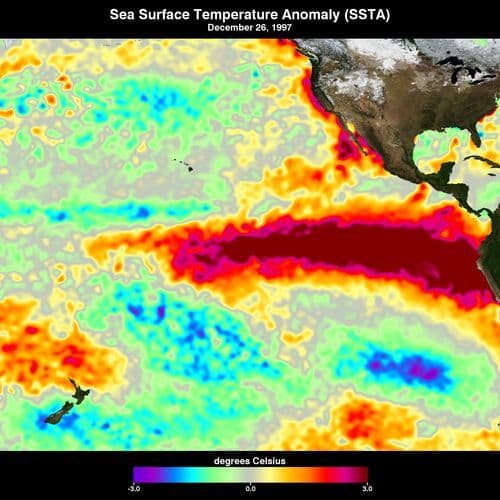
El Nino Sets Temperature Record in Key Pacific Zone: EU Monitor
Copernicus said the Nino3.4 region hit 29.70C as global sea surface temperatures reached a September record.
- On Monday, The Copernicus Climate Change Service reported that Pacific sea surface temperatures in the Nino region reached an 'all-time high' of 29.70C last month, signaling an intensifying Nino gaining exceptional strength.
- This heat exceeded peak temperatures from the 1982/1983, 1997/1998, and 2015/2016 events, underscoring the exceptional intensity of the current Nino. The natural climate cycle typically occurs every seven years.
- On Friday, Japan's weather agency reported that Nino conditions reached their 'strongest intensity on record,' with temperatures in the monitoring area 4C above normal. This record occurred before the episode's expected peak later this year.
- September was 1.63C hotter than the pre-industrial average, continuing a run of months above 1.5C. Copernicus director Carlo Buontempo stated the strong Nino will likely intensify into 2027.
- Experts warn this Nino could push global temperatures to a new record in 2027. Scientists emphasize that reducing greenhouse gas emissions from fossil fuels is crucial to limit the period of 'overshoot' above 1.5C.
20 Articles
20 Articles

The European Copernicus Observatory has seen an average sea temperature of 21.05 °C last month, and even a thermometer nearing 30 °C in some areas. An "exceptional" El Niño is at its origin, and is expected to intensify furtherThe El Niño weather phenomenon of an "exceptional intensity" has led to the warming of a part of the Pacific to unprecedented levels in September, says the European Copernicus Observatory on Monday.The temperature of the s…


Heat on the sea surface in the "Niño 3.4 region", a reference area in the Pacific, reached an absolute peak at 29.70°C in September.

The El Niño weather phenomenon of "exceptional intensity" caused the warming of a part of the Pacific to levels never before seen in September, says the European Observatory Copernicus ...
Coverage Details
Bias Distribution
- 43% of the sources lean Left, 43% of the sources lean Right


Factuality
To view factuality data please Upgrade to Premium