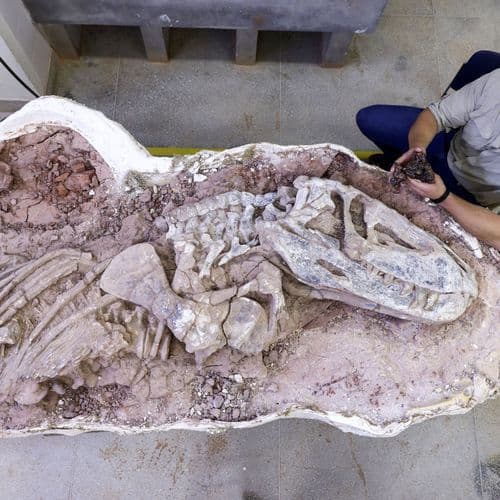
New dinosaur species discovered from fossil ‘overlooked’ for over 100 years
The tiger-sized predator fills a major gap in megaraptoran evolution and suggests the group reached Europe before spreading farther south.
- On Tuesday, University College London researchers identified Invictibellatrix amberina, a new megaraptoran species from a fossil discovered on the Isle of Wight in 1924, marking the first European identification of this tiger-sized predator.
- After remaining in a Natural History Museum collection drawer for nearly 100 years, the specimen underwent recent CT scans that revealed unique anatomical features distinguishing it as a previously unknown species.
- Published in Royal Society Open Science, Dr. Cassius Morrison's team used 3D models of the braincase to confirm the dinosaur's identity, identifying a unique hourglass-shaped crest and an oval hole where the spinal cord entered the brain.
- Unlike larger theropods, Invictibellatrix hunted small dinosaurs and mammals using agility in a niche similar to modern hyenas; Morrison noted it would have been more dangerous to humans than a T. rex.
- This discovery supports the hypothesis that megaraptorans originated in Asia, migrating through Europe before reaching Gondwana, providing critical evidence for the group's global spread during the Early Cretaceous period.
59 Articles
59 Articles


New Species of Predatory Dinosaur Identified in UK
A fossilized braincase that sat in in the collection of the Natural History Museum in London for a century has been identified as Europe’s first megaraptoran dinosaur, a lineage once thought to have flourished mainly in the southern hemisphere. The post New Species of Predatory Dinosaur Identified in UK appeared first on Sci.News: Breaking Science News.


Another paleontological mystery has been solved.

New dinosaur species, a T. rex cousin that "would have chased us," identified from fossil found 100 years ago
A fossil discovered 100 years ago in the U.K. has been identified as a previously unknown cousin of the T. rex, and it "definitely would have chased us."

A new species of dinosaur, a long-clawed predator the size of a large tiger, has been identified based on a fossil found on the Isle of Wight more than a century ago.
Coverage Details
Bias Distribution
- 62% of the sources are Center


Factuality
To view factuality data please Upgrade to Premium