Study Finds Global Fertility Below Replacement for First Time
Wikipedia File Photo




What Happened
What Happened
Where Sources Agree
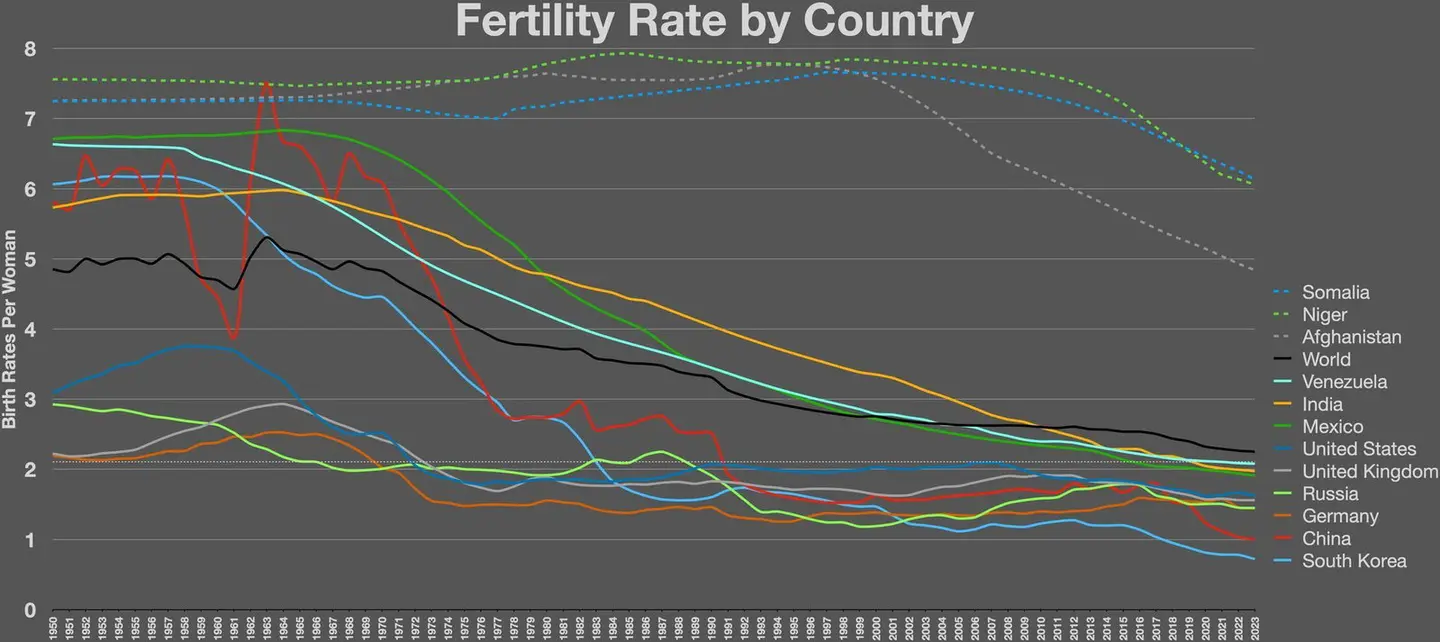
- arrows_inputBelow-Replacement Fertility Levels: Multiple sources report that the global total fertility rate has likely fallen below the replacement threshold of 2.1 children per woman, with no clear indication that birth rates will rebound, according to demographic research.
- arrows_inputModernity as Fertility Driver: Some coverage highlights modernity as the primary driver of fertility decline, suggesting this broad shift accounts for the trend across diverse societies, according to demographic research.
Where Sources Disagree
- arrows_outputEconomic Impact of Low Fertility: Mainstream analysts warn that low fertility strains pensions and slows aggregate economic growth by reducing the workforce. In contrast, recent research challenges this view, finding that lower birth rates are associated with higher growth in GDP per working-age adult, with no negative impact on aggregate GDP.
- arrows_outputFertility Data Extrapolation: Some economists argue that historical fertility data from the 1950s provides insufficient insight into today’s unprecedented ultra-low fertility regimes. In contrast, other researchers maintain that statistical models can effectively identify common global fertility components.
Timeline
August 24, 2026
Policy responses and public reaction: Authors find pro‑natalist policies (subsidies, parental leave, daycare) boost fertility only marginally; Russia has expanded childbirth payments and revived the 'Mother Heroine' program, while prominent public figures (for example, Elon Musk) have publicly warned about declining birth rates.
August 24, 2026
Projected declines and impacts: Including UN and study projections to the end of the century, populations such as South Korea and China could more than halve and Italy could shrink by over 40%; the study warns sustained ultra‑low fertility would rapidly shrink populations and strain pensions, healthcare and long‑term economic growth.
August 24, 2026
Extremely low rates documented: The authors report ultra‑low fertility spreading beyond high‑income countries — 2025 estimates include Thailand (0.87), Colombia (1.01), Iran (1.35) and Brazil (1.52) — and earlier reporting notes Thailand below 1.2 and Uruguay at 1.4; Russia's total fertility rate fell to about 1.305–1.374 last year.
Summary by Ground AI
Sources
See All 24A varied selection of sources chosen by Ground to reflect the diversity of this story’s coverage.
Most Written About
The stories getting the most coverage from the last 24 hours






Timeline
August 24, 2026
Policy responses and public reaction: Authors find pro‑natalist policies (subsidies, parental leave, daycare) boost fertility only marginally; Russia has expanded childbirth payments and revived the 'Mother Heroine' program, while prominent public figures (for example, Elon Musk) have publicly warned about declining birth rates.
August 24, 2026
Projected declines and impacts: Including UN and study projections to the end of the century, populations such as South Korea and China could more than halve and Italy could shrink by over 40%; the study warns sustained ultra‑low fertility would rapidly shrink populations and strain pensions, healthcare and long‑term economic growth.
August 24, 2026
Extremely low rates documented: The authors report ultra‑low fertility spreading beyond high‑income countries — 2025 estimates include Thailand (0.87), Colombia (1.01), Iran (1.35) and Brazil (1.52) — and earlier reporting notes Thailand below 1.2 and Uruguay at 1.4; Russia's total fertility rate fell to about 1.305–1.374 last year.


