A 3,200-Pound NASA Observatory Is Crashing Down to Earth
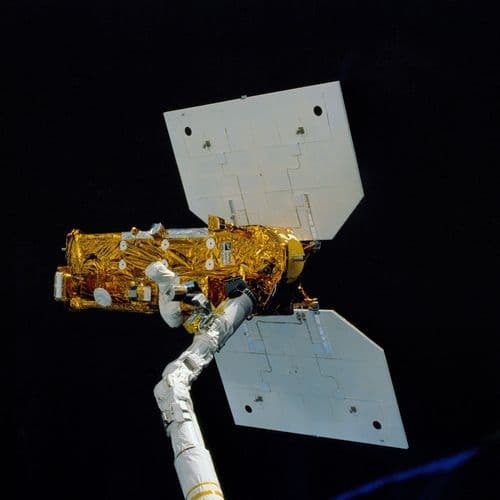
Most of the 3,200-pound telescope will burn up, but NASA says some fragments could survive and the risk of harm is about 1 in 2,100.
- On Wednesday, NASA's decommissioned Neil Gehrels Swift Observatory is set to make an uncontrolled re-entry into Earth's atmosphere, with some components expected to survive the burn-up and risk to ground populations estimated at 1 in 2,100.
- Launched in 2004, Swift was designed for a two-year mission but operated for 21 years until increased solar activity expanded Earth's atmosphere two years ago, accelerating orbital decay and forcing shutdown in late October.
- NASA spent $30 million on a rescue mission this past summer through Katalyst Space Technologies, but the startup's spacecraft suffered a malfunction, forcing the agency to abandon the effort in August.
- Recording more than 2,000 gamma-ray bursts and 1,400 exploding stars over 21 years, Swift revolutionized astronomy as a 'first responder' for celestial events. NASA Administrator Jared Isaacman said, "This is not the outcome we were working toward, but it does not change why this mission was worth attempting."
- Debris could land within a belt between 20.6 degrees south and north latitude spanning Africa, Asia, and South America, while scientists hope to apply lessons from Swift's success to future generations of space telescopes.
22 Articles
22 Articles

After nearly 22 years on mission, NASA expects any debris from the space telescope to reach an area still to be identified, without risking damage to the Earth's surface.

The remains of the American space observatory Swift will fall to Earth on November 4
The remains of the American space observatory Swift will fall to Earth on November 4.The remains of the American space telescope Swift should enter the dense layers of the Earth's atmosphere on Wednesday, November 4. The probability of harming...

The remains of the U.S. 1.5-ton space telescope Swift, which were not burned in the atmosphere, should fall on the Earth on Wednesday, reports NASA.

The Neil Gerals Swift space telescope (hereinafter Swift), which failed in NASA's first-ever rescue operation to raise its orbit, will fall back into Earth's atmosphere on the 4th (local time). This comes approximately 22 years after its launch in November 2004. NASA predicts the time of atmospheric entry is


Coverage Details
Bias Distribution
- 60% of the sources lean Right


Factuality
To view factuality data please Upgrade to Premium