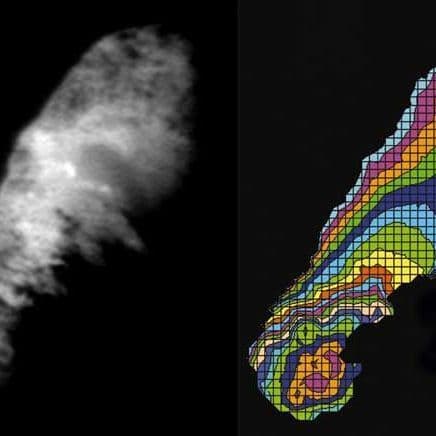
Interstellar comet that zoomed past Earth could be oldest and coldest object ever seen in solar system, astronomers say
Researchers say isotopes from Webb and ALMA point to a natural comet formed in a deeply frozen environment before the Solar System.
- On Tuesday, researchers reported that interstellar comet 3I/ATLAS likely formed in a chemically primitive region of the early Milky Way, with James Webb Space Telescope observations suggesting it is between 3 billion and 11 billion years old.
- This comet appears to have been born in a cold environment—roughly-243 C—colder than where Earth formed 4.5 billion years ago, while carbon isotope ratios indicate it formed 12 billion years ago.
- With a diameter of around 2.6 km, 3I/ATLAS is moving at more than 60 kilometers per second, faster than predecessors 1I/Oumuamua and 2I/Borisov, making it the third interstellar object ever detected.
- NASA astrochemist Martin Cordiner stated the discovery provides direct insight into the distant galaxy, while researchers noted the comet's organic molecules highlight possibilities of prebiotic chemistry elsewhere in the galaxy.
- The Vera Rubin Observatory, which came online this summer, is expected to aid future detection of interstellar objects, helping scientists move from studying individuals to a larger population to understand star formation.
68 Articles
68 Articles

Mysterious 'alien' interstellar comet could be twice as old as the sun
This series of images from NASA’s Hubble Space Telescope of the fragmenting comet C/2025 K1 (ATLAS) was taken over three days (Picture: NASA, ESA, Dennis Bodewits (AU)/Cover Images) An interstellar comet that passed through the Solar System last year may be up to 12 billion years old – far older than the sun. Scientists used the NASA/ESA/CSA James Webb Space Telescope to examine Comet 3I/ATLAS after it visited our galaxy in late 2025. As the com…

Ancient Maya Cities, Earth’s Worst Year, and an Interstellar Visitor Older Than the Sun
🌎 EARTH SIGNALS The Big Rumbles | June 25, 2026 Good morning, strange humans. Today’s signs that we’re living in the weird timeline: ☄️ The oldest comet ever observed enters our Solar System.🦠 Mars reveals new hints of ancient microbial life.🌎 Powerful earthquakes strike Venezuela and Japan.🌊 A Philippine earthquake literally creates new coastline.🌋 Guatemala’s...

A comet from another star system may be nearly 12 billion years old — almost as old as the Milky Way itself
A study published in Nature found that interstellar comet 3I/ATLAS may be up to 12 billion years old — nearly three times the age of our solar system — based on isotopic evidence showing it formed in an extremely cold, ancient environment.


Interstellar Comet 3I/ATLAS Might Be the Oldest Object Ever Seen in Our Solar System, a Study Suggests
Based on the composition of gases spewed by the icy space rock, researchers estimate that our guest might be up to 12 billion years old—about three times the age of the solar system

NASA looks for the origins of interstellar comet 3I/ATLAS | Space photo of the day for June 24, 2026
Researchers using JWST are finding clues about comet 3I/ATLAS' origins. (Image credit: NASA, ESA, CSA, STScI, Martin Cordiner (CUA, NASA-GSFC); Image Processing: Alyssa Pagan (STScI))NASA's James Webb Space Telescope is finding clues that are leading scientists closer to understanding the origins of the interstellar comet 3I/ATLAS. What is it? Comet 3I/ATLAS captured the world's attention when it was discovered nearly a year ago on July 1, 2025.…
Coverage Details
Bias Distribution
- 56% of the sources are Center


Factuality
To view factuality data please Upgrade to Premium